
Why even the most advanced Revenue Management strategies are just the beginning
How Ambitious Travel and Hospitality Businesses Can Push Beyond “Good Enough” Revenue Management
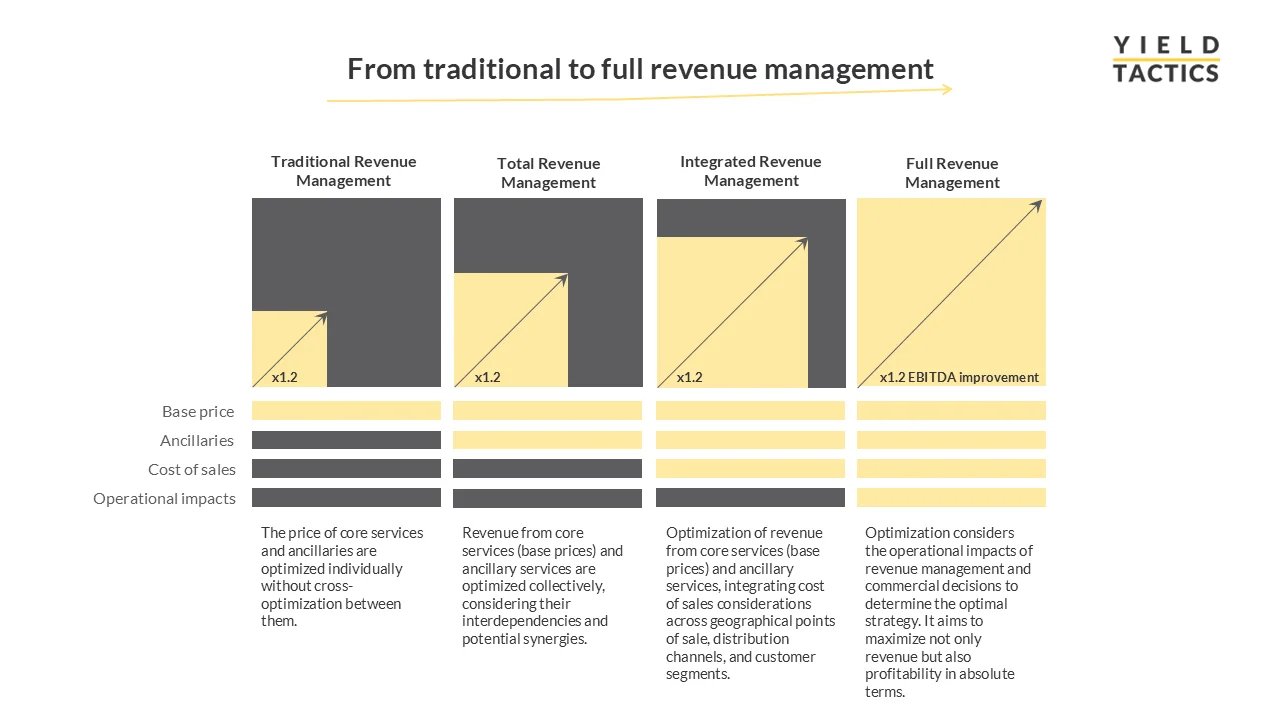
In this article, we’re diving into something crucial for any business aiming to unlock its true potential—Revenue Management. But not just any kind. We’re talking about the evolution from traditional practices to advanced, high-performance systems that drive real growth and profitability.
In our daily work with companies across travel, hospitality, and leisure, we see the full spectrum of maturity. Some businesses are still in the early stages—manually adjusting prices, relying on historical trends, or reacting too slowly to market changes. Others, like top-tier airlines and innovative low-cost carriers, are far more advanced. They’re running powerful systems, like Origin-Destination (O&D) network optimizers, automating their decisions, fine-tuning demand forecasts, and extracting revenue with near surgical precision.
They’re ahead of the game, no doubt.
But here’s the twist: even these leaders know they’re not done. There’s still more juice to squeeze. They feel it. Their systems are mature, but they want to unlock the next level. And that’s where the real challenge starts.
Because once you're already high-performing, the next leap isn't just technical—it’s strategic. It's about having a clear roadmap that lays out exactly where to go next. It’s not just about adding more tech, it’s about aligning leadership, stakeholders, and teams around the belief that there’s still major untapped revenue on the table—and the conviction to chase it.
A Roadmap to Revenue Excellence
So, how do we get there?
We needed a framework—a simple, actionable, four-step process that defines what Revenue Management is today and what it can evolve into tomorrow. And while it may look straightforward on the surface, this framework has teeth. It’s built to cut through complexity, offering clarity to businesses regardless of where they sit on the maturity curve.
Whether you're just starting to think about dynamic pricing or already knee-deep in forecast modeling, this structure helps. More importantly, it speaks the language of C-level execs, board members, and shareholders—the people who need to believe in the upside to invest in it.
This isn’t just about refining what you do. It’s about helping decision-makers understand that hidden revenue opportunities are already being captured—not just in your industry, but in others around the globe that have embraced yield management as a core strategy. From airlines and cruise lines to car rentals and entertainment venues—this model has been working for decades. It’s time to catch up or fall behind.
Our framework is the roadmap on the journey to revenue excellence. Yes, we start with optimizing revenue, but we’re not stopping there.
The real destination? Profit maximization.
Traditional Revenue Management (RM)
Now, let’s start at the beginning—what we refer to as Traditional Revenue Management. This is where it all kicks off. In this stage, businesses rely on a solid mix of advanced techniques, strategic planning, technology, and human expertise to focus on one thing: maximizing revenue from their core services. Whether it’s selling tickets for a flight or booking rooms for a hotel, the goal here is to sell the right product, at the right price, at the right time, and to the right customer.
It’s all about yield management. And once that ticket or room is almost sold, another team steps in to squeeze out any additional profit from the sale by focusing on ancillaries. Think of things like premium seat upgrades on flights or extra services at hotels. These teams apply some of the same yield management techniques to these add-ons, especially when inventory is limited, like when there are only a few first-class seats left.
But here’s the catch—this approach often ignores the cost of sales. You might know that direct online sales are typically the most cost-effective, yet there's not a lot of effort put into prioritizing one channel over another. And, in industries like hospitality or cruising, where commission fees from online travel agencies (OTAs) are often sky-high, businesses have to get a bit more strategic with how they manage their sales channels.
Moreover, Traditional Revenue Management usually only takes the financial and operational impacts into account when it’s already a problem. For example, when there’s no more space for extra baggage on a plane or when the cost of food and beverages in all-inclusive hotel packages goes up unexpectedly.
So, in essence, Traditional Revenue Management is about optimizing core services and ancillaries in isolation—focusing on revenue without always considering the wider picture. Sales costs, channel efficiency, and operational impacts tend to take a back seat. This works to an extent, but as we’ll see, it’s just the beginning of the journey. There’s a whole world of opportunity waiting once you move beyond this.
Total Revenue Management (TRM)
Let’s take it up a notch now with Total Revenue Management, or TRM. This is where things start to really get interesting. In this stage, you’re no longer looking at core services and ancillaries separately; instead, you’re bringing them together, optimizing both to maximize profit. The key here is understanding how these different revenue streams—core services and their related add-ons—interact with each other and how they can complement one another.
Here’s how it works: when a customer is considering a product, whether it’s a plane ticket, a hotel room, a cruise package, or even a train, ferry, or bus ride, the revenue management team already knows what kinds of ancillary products are likely to be sold alongside it. Think upgrades, add-ons, extra services—things like luggage fees, premium seating, onboard experiences, and so on. With this insight, the team can make more informed, strategic decisions about how to manage demand. For example, should they accept or decline a booking? Should they offer a discount to ensure a full capacity or stick to the original price? These decisions aren’t just about selling the core product at the highest possible price—they’re about optimizing the full picture of revenue, which includes all the extra services that come along with it.
This brings us into what we call “revenue trade-offs.” It’s a bit of a balancing act, where short-term compromises are sometimes made to ultimately boost total revenue in the long run. It might mean accepting a lower price for a flight or a hotel room if that choice results in higher overall revenue because of the additional sales that come from ancillary products.
For those already familiar with traditional revenue management, this is a big shift. It's about thinking beyond just maximizing core service revenue. Revenue managers at this stage might even choose to sacrifice a little short-term gain to ensure higher returns in the long run. And if you’ve already worked with concepts like displacement costs—whether you're managing group bookings, allotments, or optimizing network connections—you’ve already started moving in this direction.
The real challenge for businesses at this point is seamlessly blending core services and ancillary revenue strategies. This means looking at the entire customer journey—before, during, and after the trip—and ensuring you’re capturing every possible revenue opportunity. This kind of integration unlocks new pathways for profitability, allowing businesses to extract more from their offerings.
It’s no longer just about selling a ticket or booking a room—it’s about maximizing every touchpoint and ensuring that all the different revenue streams work together for one unified goal: total revenue optimization.

Total Revenue Management (TRM)
DiscoverIntegrated Revenue Management (IRM)
Now we’re entering the realm of Integrated Revenue Management (IRM), where things get even more strategic. The focus here is on optimizing profits by factoring in the cost of sales—something that’s often overlooked in traditional revenue management. While this concept is not brand new, it’s often been considered a concern for the sales teams rather than the pricing or yield management teams, especially in industries like airlines, where last-seat availability is still offered across all channels without much differentiation. In contrast, industries that deal with high commission structures, like hospitality, cruises, and car rentals, have been much quicker to adopt channel management tools as part of their broader Revenue Management Systems.
But IRM isn’t just about basic channel management—it goes much deeper. The real breakthrough here is the integration of net revenue considerations into optimization models. Instead of solely focusing on maximizing gross revenue, IRM looks at net revenue, which can vary depending on the channel, customer segment, or profile. In simpler terms: it’s not just about how much money you’re bringing in from a sale; it’s about how much profit you’re actually making once you factor in costs like commissions, distribution fees, or other sales-related expenses.
This shift moves revenue management toward its ultimate goal: maximizing absolute profit, not just chasing top-line revenue figures. By incorporating the true cost of sales across different channels and customer segments, businesses can develop much more refined revenue strategies that not only optimize sales but also drive higher profitability.
Adopting an Integrated Revenue Management framework is truly transformative. It requires a much deeper understanding of variable costs across all areas of sales and distribution. This approach takes into account commission-like costs, but it should go even further by considering all variable costs tied to getting the product in front of the customer. Once businesses widen their scope to include these costs, they can fine-tune their pricing and revenue strategies to achieve more sustainable, long-term profit growth.
In essence, IRM brings together all the elements of pricing, sales channels, and customer profiles with a laser focus on net revenue—turning a complex landscape into one where every decision is geared toward the same goal: maximizing profit, not just revenue.

Integrated Revenue Management (IRM)
DiscoverFull Revenue Management (FRM)
At the pinnacle of revenue management lies Full Revenue Management (FRM), where the focus isn’t just on maximizing revenue, but on optimizing profitability in absolute terms. This is the stage where companies take into account the operational impacts of their revenue and commercial decisions, integrating them into their revenue management strategies to achieve the most effective outcomes.
A classic example of this concept can be seen in the airline industry. Traditionally, airlines faced a trade-off between volume and yield—the idea that both low volume, high-fare tickets and high volume, low-fare tickets could optimize revenue. However, when you factor in operational costs, such as check-in, baggage handling, onboard catering, and even the additional fuel consumption from carrying extra weight (such as an additional 100kg of passenger and baggage weight), the dynamics of this balance shift. When these operational costs are brought into the equation, the ideal trade-off point changes, illustrating how important it is to factor in all costs when making revenue decisions.
In the FRM model, businesses move beyond simply balancing net revenue and ancillary revenues. The goal is to optimize EBITDA—earnings before interest, taxes, depreciation, and amortization—by fully considering operational-related variable costs. This sophisticated approach enables companies to hone in on true profitability and drive sustainable profit growth.
Implementing FRM is no small feat. It requires cross-departmental collaboration, touching nearly every part of the business, from operations to sales to finance. The good news, however, is that businesses don’t need to completely overhaul their systems to begin embracing FRM. The key is to merge and reinterpret non-traditional revenue management data, integrating these insights into existing processes.
For businesses that adopt this approach, FRM presents the opportunity to unlock incremental revenues and profit, positioning themselves as leaders in a rapidly evolving and increasingly competitive market. While it may take years for this methodology to become the industry norm, those at the cutting edge will benefit from the competitive advantage of truly maximizing profit—not just revenue—across all their operations.
In essence, Full Revenue Management is the next frontier of revenue optimization, focusing not just on top-line revenue, but on ensuring that every decision contributes to maximized profitability in the most comprehensive sense.

Full Revenue Management (FRM)
DiscoverThe Path to Full Revenue Management is a Journey of Incremental Gains
It’s crucial to remember that the journey toward achieving Full Revenue Management (FRM) isn’t a straightforward, linear progression from one stage to the next. Instead, it’s a dynamic journey of incremental gains, where each stage builds upon the last. Most yield-oriented businesses in the travel and hospitality sectors have likely already incorporated elements of Total Revenue Management (TRM), Integrated Revenue Management (IRM), and Full Revenue Management to varying degrees.
If you were to ask us to assess your maturity level, we wouldn’t simply give you a blanket answer about which of the four stages you occupy. Rather, we would approach it from a holistic perspective. Our focus would be on evaluating your potential for improvement across these four stages and estimating the revenue gains you could achieve by mastering each stage more effectively. Every company is at a different point in this journey, and the ability to unlock value from Total Revenue Management, Integrated Revenue Management, and ultimately Full Revenue Management, depends on identifying the specific areas where you can make incremental improvements.
If at any point, you feel that these revenue management concepts seem abstract or theoretical, we encourage you to continue exploring with us. As we move forward, we'll demonstrate how these ideas translate into practical strategies and real-world examples. By embracing a step-by-step approach and understanding how to apply these strategies to your unique situation, you’ll be well on your way to maximizing your revenue potential and unlocking greater profitability in the long run.

Willing to seize this business opportunity? Facing a challenge?
Discuss your needs with a Yield Tactics Principal Consultant on a video call.
Book your date/time
Yield Tactics Magazine
Stay ahead with Yield Tactics Magazine — a resource full of expert perspectives on revenue strategy, dynamic pricing, and optimization techniques.
Download
Diagnostic 360 - Organizational audit
Read
5 winning pricing strategies for travel companies
Read
Network O&D revenue maximisation without RMS
Read
From Branded Fares to Matrix Pricing
Read
BOOSTING revenues of a theme park
Read
Revenue Management Maturity Across Industries
Read
Why Contextual Pricing Beats Personalized Pricing
Read
Advanced Revenue Management
Read
Catch the Fresh Wallet Before It’s Gone
Read Total Revenue Management (TRM)
Read Integrated Revenue Management (IRM)
Read
Revenue is Everywhere
Read